Conquer oneself and "the inner enemy"
Little WomenIn Little Women, self-conquest is the inward form of the family’s larger pilgrimage through hardship. The “bosom enemy” is not an external rival but the fault within—quick temper, selfishness, vanity, pride, resentment, or despair—that can injure others and deform the life of the person who obeys it. The March family treats moral growth as active labor: each person must recognize a burden, resist it repeatedly, and learn to replace impulse with duty, sympathy, and deliberate goodness.
The Moral Vocabulary of the Family
The language of inward conquest is introduced through Mr. March’s letter from military service. He sends love to his daughters, prays for them, and urges them to use the waiting period productively: they are to work, perform their duties faithfully, fight their “bosom enemies” bravely, and conquer themselves so that he may return to daughters of whom he can be even prouder. The phrase joins affection to discipline. Mr. March does not imagine goodness as passive innocence; he expects the girls to take responsibility for the forces within them while the family endures separation and uncertainty.
Mrs. March then converts that instruction into the structure of the girls’ daily moral education. Recalling their play based on The Pilgrim’s Progress, she explains that the burdens represented in the game are present in real life, that the road lies ahead, and that the longing for goodness and happiness guides travelers through troubles and mistakes toward the Celestial City. The game therefore becomes a serious pattern for living. Its bundles symbolize personal faults, while its journey gives moral effort a direction: growth proceeds through repeated error, correction, and renewed effort rather than through a single moment of perfection.
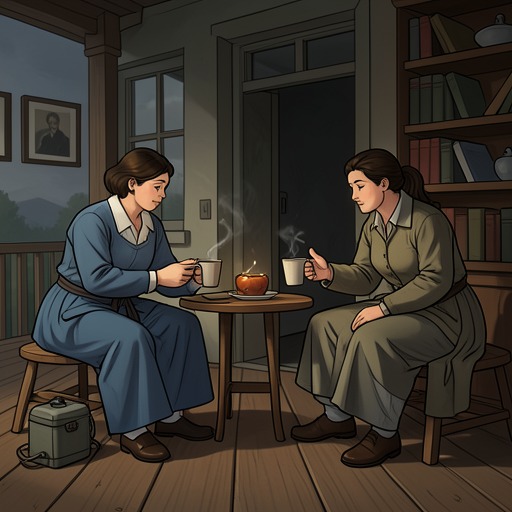
The family’s teaching also rejects the idea that virtue belongs only to those who appear calm. Mrs. March tells Jo that she has struggled with anger for forty years and has learned to control its expression, though she still hopes eventually not to feel it. She manages the danger by checking hasty words, leaving the room for a moment, and recovering self-command before anger speaks for her. Her example makes moral authority experiential rather than merely verbal: she asks the girls to practice a discipline she has practiced herself.
Jo and the Discipline of Anger
Jo’s quick temper provides the clearest embodiment of the “bosom enemy.” Her quarrels with Amy repeatedly move from teasing and irritation to violent emotional explosions. Jo is ashamed afterward and sincerely repents, but repentance does not immediately cure the fault. The narrative emphasizes the recurrence of the struggle: her anger can flare up despite her efforts, and the need to master it extends across years of patient work. Her moral problem is therefore not simple disobedience but the frightening knowledge that passion can temporarily overpower judgment.
The crisis surrounding Amy’s fall through the ice makes that danger unmistakable. After the quarrel, Jo realizes that her hardness of heart helped create the circumstances in which Amy was left vulnerable. When Amy is brought home safely, Jo fears that her sister might have died and that the death would have been her fault. Her remorse is not abstract; it is tied to the possibility that an angry impulse could produce an irreversible consequence. She confesses that, when enraged, she feels capable of hurting someone and taking pleasure in the hurt, and she fears that her temper may one day spoil her life and make everyone hate her.
Mrs. March answers neither with denial nor with easy reassurance. She tells Jo to watch and pray, never to stop trying, and never to believe that the fault is impossible to conquer. She also gives Jo a practical model inherited from her marriage to Mr. March: when sharp words rise, she leaves the room, and Mr. March supports the effort with a quiet gesture and a sober, kind look. The method depends on relationship as well as willpower. Jo must ask for help, recognize the warning, and create a pause between feeling and action.
The result is not instant transformation. Later, a letter from Mrs. March praises Jo’s efforts to control her temper, noting that her unseen trials and failures have begun to bear fruit. Jo responds that her mother’s approval is worth more than money or vast quantities of praise and promises to continue. Self-conquest thus becomes a process measured by persistence: success means that the effort is becoming habitual, not that temptation has disappeared.
Amy, Punishment, and the Growth of Self-Knowledge
Amy’s development shows how external punishment can become internal moral understanding. At school she brings pickled limes despite a rule against them. When the limes are confiscated and she is ordered to carry them away, the public humiliation culminates in Mr. Davis’s punishment. He insists that rules must not be infringed and strikes her palm when she refuses to offer her hand. Amy experiences the blows as a profound disgrace because they expose her conduct before the whole school.
Mrs. March refuses to offer the sympathy Amy expects. She says that Amy broke the rules and deserved punishment for disobedience, while also making clear that she does not approve of corporal punishment or Mr. Davis’s manner of teaching. This distinction matters: Amy is not taught that every authority is right, but she is required to recognize her own responsibility. Mrs. March further warns that Amy’s growing conceit can spoil talent and virtue. Genuine ability need not be paraded, because real goodness or talent will eventually be recognized, while the possession of gifts should produce modesty rather than display.
Amy later identifies selfishness as the largest item in her “bundle of naughties.” Her proposed remedy is deliberately concrete: she wants to wear a ring as a continual reminder of her resolution to think less of herself. She also chooses Beth as her example, observing that Beth is unselfish and therefore deeply loved and missed. The motive begins partly in a desire to be loved, but it develops into a conscious attempt to shape character. When Mr. March observes that Amy has run errands, yielded her place, served others patiently, neglected the mirror, and refrained from displaying her pretty ring, he recognizes that she is learning to mold her character as carefully as her clay figures. The contrast between a graceful statue and a lovable daughter makes moral beauty superior to artistic accomplishment.
Self-Control as Shared Emotional Labor
The principle extends beyond Jo and Amy to the regulation of family relationships. When Mrs. March leaves the household during a crisis, she instructs the girls not to become idle or lose themselves in fretful grief. They are to hope and keep busy, continuing their ordinary work because labor is a blessed solace. This counsel treats activity as a discipline that gives sorrow a constructive form; emotional endurance is not the denial of feeling but the refusal to let helplessness govern the household.
Marriage provides another test of the same principle. During Meg’s first serious disagreement with John Brooke, she recalls Mrs. March’s warning about hasty words, pride, and the need to ask pardon first when both partners have erred. Her anger now looks childish to her, and she recognizes that refusing reconciliation would establish a damaging pattern. Pride makes the approach difficult, but she crosses the room and kisses John on the forehead before speaking. The gesture ends the quarrel, and John also acknowledges his fault. Self-command here is not submission to another person; it is the deliberate surrender of vanity for the sake of mutual respect and peace.
Mrs. March applies the principle similarly when she tells Meg that young motherhood has caused her to neglect her husband in her devotion to the children. The mistake is natural and forgivable, but it must be corrected before separate habits divide the marriage. She advises Meg to make home pleasant enough that John will want to remain within it. Emotional responsibility therefore includes attention, communication, and the active maintenance of bonds, not merely the suppression of angry speech.
Grief, Compassion, and the Limits of Mastery
Beth’s approaching death gives self-conquest its most difficult form. Her faith does not make life unpleasant or death desirable; she admits that life is sweet and can only say that she is trying to become willing to relinquish it. Her courage appears in conduct rather than elaborate explanation. She leaves the matter to God, nature, and the love of her family, accepting help without pretending that separation causes no pain.
Jo’s response reveals the difference between mastering a fault and erasing an emotion. She rebels against the possibility of losing Beth, promises to fight the approaching tide, and insists that she cannot let her sister go. Beth does not answer with a sermon or condemn Jo’s passionate resistance. Instead, she loves Jo more for that affection and clings to the human love through which spiritual consolation is understood. The scene does not require Jo to conquer grief by becoming cold. It asks her to endure grief without allowing rebellion to destroy love.
After Beth’s death, Jo repeatedly wakes at night thinking she hears her sister. The empty bed brings an unresigned cry for Beth to return, and Mrs. March comes to comfort her through touch, tears, and patient presence. Jo’s burden becomes easier not because sorrow vanishes but because grief is shared and transformed into deeper love and duty. The family’s ideal of self-conquest therefore has a crucial limit: the self is not meant to defeat feeling itself. It must learn to give feeling a humane direction.
Significance of the “Bosom Enemy”
The recurring image of the inner enemy organizes Little Women as a sequence of moral transformations. External events—school discipline, family quarrels, marital misunderstandings, separation, illness, and bereavement—serve as tests that reveal inward habits. The decisive conflict is what each character does with the emotion released by those events. Anger can become restraint, shame can become humility, selfishness can become service, and grief can become compassion, but none of these changes is automatic.
The concept also makes virtue relational. Mr. March’s letter, Mrs. March’s example, Mr. March’s silent signal, Amy’s concern for Beth, Meg’s return to John, and the family’s care during Beth’s decline all show that self-command is learned within bonds of affection. People become capable of governing themselves because they are watched, trusted, corrected, forgiven, and needed by others. The “bosom enemy” remains formidable precisely because it is intimate, but the same intimacy supplies the patience and love through which it can gradually be subdued.